

This post contains affiliate links. If you make a purchase using them, we will receive a small commission at no extra cost to you. It helps to keep this site running – thank you!
Welcome to Day 19 of 30 Days to Packing a Better Bag.
Today’s topic is about something that many people overlook when they first start adventuring: the essential travel medical kit.
We knew we wanted to prepare the essential list for you ladies, but after further inspection, we’ve decided that there are too many variables to be able to give one, finite list.
- Some women may have health issues (chronic allergies perhaps) that require extra medications and cause their medical kit to expand.
- While some ladies might simply be heading across country for a quick 2-week tour of a major city and therefore need hardly any medication.
Since we can’t give you one fail-safe packing list, we decided to give you several recommended items, plus a few tips that can help you minimize what you decide to pack.
You’ll want to put a little time into this task.
Why?
Because a well-packed essential travel medical kit can be a lifesaver.

Get the Companion Workbook!
This workbook is your dedicated space to work out each day of the 30 Days to Packing a Better Bag series. It’s available as both an editable and printable PDF as well as a Google Doc version.
Evaluate Your Medical Needs According to:
Your Trip Style and Destination
Part of this 30 days project has been for you to recognize your trip style and preferred destinations. This will obviously impact the amount and types of products that will need to go into your medical kit.
- Taking a road trip to major cities across the USA? Chances are you won’t need to pack much into your medical kit since pharmacies and doctors will be accessible (and understandable).
- Heading to the remote wilds of Central Asia or Mongolia? Then you will want to have a mini pharmacy in your bag at all times.
- Going camping and hiking in the wilderness? You’re going to want a good medical kit that can get you by several hours or days should an emergency arise.
- Traveling to a country where medical treatments and medicine are less regulated? You’ll want to be as prepared as possible, within good reason of course.
- Heading to a destination where English is not widely spoken? While medicine may be available, you will probably want to lessen the chance of pharmacy or doctor confusion by having some supplies with you for your basic needs. Think colds and female issues.
While packing your essential travel medical kit, make sure you keep these things in mind.
Your Personal Health
Before setting off on your travels, you need to think about your own personal issues and the likelihood that you will need something important in a random country abroad.
- For example, are you a female that gets more frequent UTIs? You’ll want to pack some medicine for that when traveling on more adventurous trips.
- Do you tend to get the dreaded yeasty beast on occasion? Especially after taking antibiotics (which you might be more likely to need on certain trips)? Yes, pack medicine for that, too! The last thing you want on your Euro Adventure is to be stuck in a doctor’s office getting your lady parts checked out by someone you can barely understand.
Think about the medicine you use on a more frequent basis and make sure you have plenty for your travels.

The Basic Kit
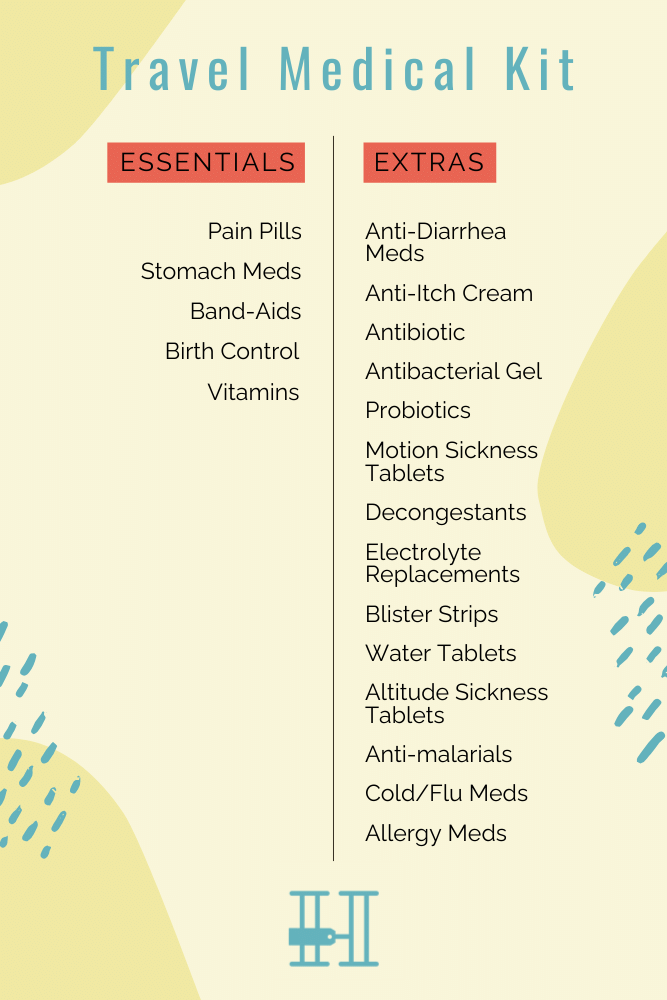
For shorter, city-bound jaunts your travel medical kit might consist solely of some aspirin, stomach soothing meds, and band-aids. Here are the items to consider:
Pain relievers: For the random headache or hangover. Something like aspirin or acetaminophen.
Stomach meds: Think Pepto Bismol or Mylanta. Chances are you might have a few extra drinks or servings of delicious food on your travels that may throw your stomach out of whack. Add jet lag, and your stomach might be even more confused.
Band-aids: These are so important for the blisters that so regularly pop up when you’re walking a lot more than normal. Also good for shaving cuts and other random small issues that might be in need of a quick fix.
Birth Control: Whether condoms, pills, or both, you should always be prepared and stay regular.
Vitamins: A good multivitamin can be your best friend when you travel since our diets often go out the window. Combined with added travel stress, time changes, and more public transport use, a vitamin might be just what the doctor ordered.
- Check out this post if you’re someone traveling with food allergies.
Extras to Consider
Anti-Diarrhea Meds: For destinations with sketchy food and water. These (think Immodium) can be a lifesaver, but not a cure.
Anti-Itch Cream: For bug bites and small skin reactions. If you’re heading to a mosquito prone destination, this is essential. You might also want to consider packing some bug repellent gear.
Antibiotics: A broad-spectrum antibiotic can cure a slew of ailments while traveling. ONLY take as recommended by a doctor, and not for something like the sniffles or a mild upset stomach.
Probiotics: The kind that don’t need to be refrigerated. If you’re in a country that can do a number on your stomach or if you have to take antibiotics, then these are a great addition.
Antibacterial Gel: For applying to minor cuts and abrasions. When traveling in less-than-fresh locations, a little antibacterial gel (think Neosporin) can make a huge difference.
Motion Sickness Tablets: For boat rides and long bus rides through the mountains. If you’re prone to motion sickness in general, you may want to keep some in an easy to reach place in your bag for easy access while traveling.
Decongestants: Essential if flying with a stuffy nose.
Electrolyte Replacements: Again, essential in places where you might have stomach issues or will be exerting yourself in the elements.
Blister Strips: If you’re doing extra walking or hiking, a blister strip can help alleviate ongoing pain and issues.
Wound Cleaning: Alcohol or iodine swabs, gauze, and medical tape.
Water Tablets: In many locations, it is possible to buy bottled water, but more remote travelers will survive on iodine tablets.
- Take a look at this post for more information: Should I… Pack a Water Purifier?
Altitude Sickness Tablets: Certain mountain destinations, like Everest or Kilimanjaro, can cause altitude sickness if you’re not taking the proper precautions.
Anti-Malarials: Research your destinations in advance so you can be sure to stock up on the correct type of anti-malarial pills. Insect repellent is also important in these destinations.
- Talk to your doctor about travel vaccinations before your trip.
Yeast/Thrush Infection Treatment: Go for a tablet instead of cream as it will be easier to carry.
Cold/Flu Meds: Only if you don’t think you can get these at your destination.
Allergy Meds: If you suffer from allergies, don’t forget these.
Extras: Tweezers, safety pins, and mini scissors.
Essential Travel Medical Kit Packing Tips
1. Go for tablets over liquids, gels, and creams.
Pepto tablets over liquid.
Pain tablets instead of pain cream.
Antihistamine tablets over cream.
That way you don’t have to worry about your medical kit contributing to your liquids allowance when traveling carry-on only.

2. Go for sachets and flat-packed tablets instead of tubes and bottles.
Bottles are the ultimate space-suck.

3. Look for travel size packaging.
Ask your doctor for sample size products that you can take with you on your trip. They will more than likely be enough product but will save you space in your kit.

4. Remove items from boxes or flat-pack boxes to save space.
If your medicine doesn’t have instructions on the individual items, be sure to keep leaflets, or cut out the instructions from the box and secure to medicine with a rubber band.
ONLY remove items from bigger boxes if they are individually packaged and labeled. Loose pills are a no-no!

5. Store items in the empty space of bottles.
If you must take bottles, use the empty space for individually packed (and labeled!) aspirins and the like.

The Essential Travel Medical Kit: Further Tips
- Only take as much medicine as you will need. For most trips, this is just enough to get by until you’re able to find a pharmacy to replenish.
- Choose multi-purpose alternatives. For example pack one cream that can be used for blisters, cuts, bites, and minor burns rather than packing four separate creams.
- Always visit a travel doctor before big trips. This will ensure you have the knowledge and gear necessary before a trip. It is also important to make sure the medications won’t interact with something else. For example, some antibiotics interfere with birth control pills. These are things you will want to know, ladies.
- Research emergency contact details before you go. Every country has different emergency numbers. This might include medical emergency services, the embassy, an ambulance, etc. Make sure you research these and keep them somewhere you can access easily. Or even better, make sure you memorize the emergency number.
- Be aware of any legal considerations. Some medications may be restricted in certain countries or may require special documentation.
- Always check the expiry date of the medication in your essential travel medical kit. Before every trip make sure none of your medication is expired.
- For more tips, take a look at this post: Tips for Packing Medications When You Travel
Take Action: Prepare Your Medical Kit
Think about your trip style, destination, and any medical needs you have before your trip. Also take into account the different situations you might be put into on your travels.
Prepare your ultimate medical kit, starting with the basic kit and adding any extras you may need. Make sure to think about size and space in the process.
Is there anything not here that you can’t travel without? Let us know in the comments below.
- PREVIOUS – Day 18: The Essential Travel Beauty Kit (for light packers)
- NEXT – Day 20: Health and Hygiene Packing Considerations
Pin these to your favorite boards




Thanks for this awesome article! I’m notorious for getting some kind of injury while travelling. For example, I’ve had a blockage in my gallbladder, stung by two very large jelly fish at once, fell off a raft and landed on some very hard rocks, got pinned under a tree under the water… The list goes on. However, what do you recommend for a person that is on a lot of different medications? I have a whopping 10 pills I take a day. I was thinking perhaps pouring what I need into zip lock bags and labeling them? I have an AM/PM pill holder, but I don’t think that would be the greatest thing to take in a bag, especially because it pops right open. Nothing like searching through your bag for a pill the size of half your pinkie nail!
You can buy teeny bags at craft stores and make up as many bags of meds as you have days on the trip. Take a few extra days of course but the bags can be thrown away once used or repurposed and dont take up the space of a pill box.
I have done that exact thing myself! Mini plastic bags can be a lifesaver! Plus you can suck all the extra air out. 🙂
Hi…just wondering if there are requirements in regards to medications being in original,labelled packaging when travelling internationally? I am heading off on a 6 month backpacking trip so I have to take quite a lot with me (daily med, pill, vitamins, anti-malarial, and other meds as mentioned for headaches, stomach upsets etc)….so I’m worried about how much room this will take up!!
As a general rule, you need to have pills in their original packaging. So, if you pick up some antimalarials from the doctor, they should stay in that bottle and labeled (ask your pharmacist for a smaller bottle if possible). You should also have prescriptions/notes with those types of medications. For things like pain pills, etc., go with things that are individually packed and labeled… like pepto bismol tablets that are packed in tear-off sheets and are clearly labeled on each as pepto. Any pill sheets are going to be easier to pack than bulky bottles. If traveling to destinations where maybe certain medications might not be legal, check with your embassy. Take only as much as you think you’ll need. If traveling to fairly Western destinations, you will most likely be able to pick up extra headache meds, stomach meds and vitamins as you go.
Thanks Brooke! I had read that info about the doctor’s note regarding medications and I just wasn’t sure how much I could cut down on the packaging for my medication (putting more strips into one box). I am heading to numerous countries in South America and also to the USA. We leave in just over two weeks and the reality has set in and I am starting to get stressed! Hahahaha
By the way…I LOVE this site and wish I had found it months ago when I first started packing!!! Keep up the fantastic work!!
Great article! I unpack all of my meds and then bundle them together using my hair ties – when I’m finished my meds I have spare hair ties to use to replace the ones I loose along the way!
One thing that a lot of people forget to bring is Benadryl/allergy meds. While traveling in a different country or even a different city you are around different areas, foods, etc. I didn’t know I had a sudden allergic reaction to ginger until it would have been too late. Luckily I had Benadryl in my purse and I was able to take that before my throat closed all the way up. This is a NEED if you are going anywhere, it could save your life!!
This is so true! I had a weird allergy in a field camp and got a rash, didn’t have any allergy medication and I was saved by some flu pills that had antihistamines. After that I always carry Benadryl. Also, I got a weird allergy to fungus and spores and cannot stop sneezing, need to prepare for that too. I am planning a long term trip to Africa and adding all this super useful info.
If I can’t take my meds in their original packaging, like when it’s a huge pill bottle or the long gone boxes my epi pens & inhalers came in, a week our so before I leave I ask my pharmacy to print out a bottle label for each prescription I’m taking. That way if a TSA agent needs proof that at it’s my med, I’ve got it.
Thanks for your wonderful, helpful website. Great ideas for a chronic overpacker. I spend three to four months in one location every year, so I’m basically living wherever I happen to be, however, as a renter, I can’t leave a permanent stash, but must pack afresh for each trip.
I bring an assortment of cream medicines, such as anti-itch, muscle relaxant, antifungal, antibacterials in contact lense cases. Squeeze an amount into one of the little cups, close it up and using an indelible pen ( Sharpie ), print the name of the medicine either on the face or bottom of the container. Even liquids such as Betadine or a veggie wash can be put in these. They’re sturdy and for extra safety, can be sealed in a ziplock sandwich, or even a snack size zip bag.
I even use these for prescription creams (rosacea), but I haven’t crossed any iffy borders into third world countries. I do take photos of my Rx’s and keep those on my ipad.
I’ve rarely needed to purchase a larger size at a pharmacy, but at least I have enough for an urgent moment until I can get more.
A hard-earned tip: Don’t assume you’ll be able to get the same OTC drugs you did at home just because you’re traveling to a big western city. I got a cold/flu my first few days on a trip to Germany and had to haul my butt out to the local Apotheke, where they’d only give me ineffective herbal remedies. (No disrespect to effective herbals, but these did not help.)
Now I keep a small pouch filled with Nyquil, Dayquil, and other OTCs from home so I can hunker down with remedies that I know work instead of having to hunt while sick for something that just might help. Experiment with foreign shampoo and snacks, not medications!
My travels are to places without doctors or chemists so I need to take something for all potential occurrences. For sheer space saving – I use the tiny snack sized zip locks – about a third the size of a lunch one. i keep all pills in blister packs and I cut out the box showing the name and the prescription sticker. I label the bags – tummy, pain, allergy, colds. I get my doc to prescribe me several types of broad spectrum high dose antibiotics – pack of 3 pills for one per day so small to back. sachets of cranberry UTI and orange electrolytes are a mainstay. Super useful find lately has been stick on hot and cold packs. Lovely slimline ones that stay hot or cold for up to 8 hours in situations where you cant access an icepack or heat pack. The two hot ones I have tried are Hotteze and Nurofen from chemists, and cold ones were a Migraine Cool and Soothe which I found in the Post Office. All are small flat and compact to tuck into a slimline first aid bag. I tossed out most of the creams and potions and stick with Lucas Paw Paw for just about everything.
It is important to include the expiration information on any medications you pack away from their original packaging. Some blister packs include the expiration date with each pill (which is great!), but some do not. So if you are cutting out only part of the original box, include the expiration date.
I keep ibuprofen, Benadryl, etc. pills in little 6 compartment box I found at Target years ago. I write the name of the pill on the cover, even though by now I know them by sight. Since the pills are loose, whenever the bottle they come from expire and I buy a new bottle, I dump out the old ones in my pill box and replace them with pills from the new bottle. That way, I know the pills are always good.
Thanks for the article and all the helpful tips.
I do have one point. Why would you take antibiotics? How often do you need them every 5-10 years? In the US they seem to prescibe antibiotics for everything. If you have a virus it won’t do a thing. Plus it will do a number on healthy gut bacteria. Which is not helpful if you are abroad. And if you do not take the whole package in x number of days you help bacteria to become more resistant. People have died recently because antibiotics don’t work anymore. This is a secious issue! Look up podcasts from the house call doctor on quick and dirty tips. She is a real doctor and has also some podcasts about travelling and medication. But look up the one on antibiotics!
@Robin I’m sorry you didn’t get anything that worked. In Germany and the Netherlands and probably other countries you only get over the counter medication. You need to see a doctrine for a prescription. Even if you have taken it before. They are not allowed to give it to you. In the Netherlands it’s best to go to a normal doctor because it’s faster.
You bring antibiotics on a trip because you may get a bacterial infection that might not clear up in its own. If you are a long way from medical help, this can turn into an emergency situation. Certainly no one should be taking antibiotics for a case of the sniffles but antibiotics are a must when it comes to severe traveller’s diarrhea, some sinus infections, infected cuts/scapes/wounds, seriius animal bites/stings.
I have a long list of documented/genetic chronic diagnoses, several rare disorders, and immunodeficiencies (my PCP told me I’m “overqualified” for disability/SSDI). I LOVE to travel but need to be prepped for any issues that arise – including chronic infections that have landed me in the hospital. My primary care and travel docs always make sure I take along a course of antibiotics in case an issue arises – like a kidney infection or significant gut issue. In spite of being verrry careful about what I consume, I ended up with cryptosporidium that went on for 6 mo and nearly killed me. My husband has a god-like immune system – his crypto lasted 3 days. Canapple makes very valid points. PS – this site is awesome.
I just returned from hiking Inca Trail (Peru) where I got travelers diarrhea along the trek. Azithromycin is the new recommended antibiotic rather than cipro. You might want to verify this through travel medicine doctor. Also, I like the electrolyte chews. They are heavier but contain some sugar and are easier on the stomach if you are really sick and need to stay moving on the trail.
Great packing list! I am looking forward to a 3 month trek through South America in a few days and putting together a med kit right now. I want to really caution readers against Cipro as a cure-all antibiotic. Cipro is one of the hardest hitting antibiotics that is prescribed orally and in almost all cases the equivalent of bringing an uzi to a knife fight. If you want to bring an antibiotic, choose a more mild one, or purchase one at a local pharmacy.